Blog#5 The million dollar question-Are you in Sales?

The situation around the world is grim, the pandemic has hit us economically but more so made us realise the fragility of our lives, our existence and the importance of our co-existence with nature. The last being the most important and a reminder to us, the humans to mend our ways.

Organisations and institutions across the world have enforced the ‘Work from Home’ rule, cities and provinces have instituted lockdowns and that seems to be the right step at this juncture to overcome the pandemic. However, one can’t help but think of the people in blue collar jobs or labourers who tend to lose their daily income because of these steps, if not compensated adequately by the governments or the companies they work for. In the corporate world, the biggest impact can be felt by sales professionals. Even if the companies reduce their top line projections or guidance, the target pressure may reduce for these professionals but they still take a haircut on their income or compensation which would typically be weighed more towards the variable (the commission or incentives) that they earn from their sales performance. Right now the test of mettle is how innovative the companies can get to ensure they keep themselves afloat and develop new ways to present their products and services to the clients and customers.

My story in sales starts from the time I decided to leave the Army and got myself a post graduation in business administration. I realised that being in combat, in the front faced with all of the action was more of a habit which made me yearn for a similar adrenaline rush in the corporate world. Being the face of a company or a product and leading from the front (in the literal sense) seemed to be more plausible in the sales function which brings in the bread home for an organisation. As I made that decision during the course, the first and early reactions erupted from my family and friends. “Are you going to sell door to door”, “Aren’t you doing well in the course”, “As an Ex- commissioned officer of the Indian Army, aren’t you marginalising yourself”, were the few among several questions that were thrown at me. The best however was from my granny, “I always thought you were intelligent, but your father encouraged you to join the Army and now you take this further towards sales? why couldn’t you have become an engineer”? As if I wanted to become one and as if this was being handed over to me on a platter. She apparently didn’t hear about my tryst with calculus and trigonometry. She made a cute plea to see if she could drill some sense into me.

However, the biggest challenge lay ahead as I prepared for the corporate placements through the last few months in college. Corporate recruiters didn’t see veterans as ideal people for sales. The cliched remarks were that veterans were good in administration, operations, human resources and supply chain; which they definitely are but also are good in managing teams, objectives, goals, targets and devising strategies to achieve them. These dogmas propelled me to think creatively to find repertoires which could convince them that I was the right person for sales and one person whom we fondly called ‘Naga’ our program director passionately pursued. What did I do? I culled up my experiences in army of mapping my area of responsibility (AOR) in combat zone which is called a grid reference based eye sketch of residents, villages, houses, institutions (exact location) as a market mapping capability which is a key skill in sales. I spoke about my attempts in negotiating surrenders of terrorists in dire circumstances to endorse my negotiating skills. I showed them how we used to shadow terrorists in mountainous and jungle terrain for days to display my perseverance and doggedness. I narrated instances of how all the combat ops that we undertook didn’t yield the desired results which again proved of my perseverance and patience to do the same activity again and again, a very important skill for any sales professional.

Finally, the ‘Argumentative Indian’ in me convinced a few of them that I was apt for the job and thus I began my second journey of learning. I tried my hand at B2C (Business to Consumer), B2B (Business to Business), S&D ( Sales & Distribution) and these experiences brought in some tangible but immense intangible learnings. Few are worth mentioning.

Game of Probability– Perseverance (at the cost of repetition!) plays a big role on how successful a sales professional can you be. The more you try and keep trying actually increases your chances. The ideal sales funnel is one close in five, but that ratio starts with one close in fifty and the progression is based on how you ‘bash on regardless’.

Be the best student of Rejection– This is your best teacher. Every rejection teaches you what not to do the next time and if you look back at your attempts you see a pattern which you may need to break.

Present facts as a Knight– Don’t get too caught up in the technicals. The client or the customer sees you as a saviour of their problems and not a professor who is writing his thesis. Knowing your product or service is good but how shall that help your customer is the key. Be succinct and keep polishing your elevator pitch always. Be their knight in shining armour.

Fib and it shall cost you– Being the knight could also compel you to brag about some features to your customer or client which may seem like a dream to them but, may not be true. Its like telling a bald person who is desperate to regenerate his hair that this comb that you sell, shall make his dream come true and if it doesn’t, he gets his money back albeit not from you, since you would be long gone!!! Life is a circle and this ought to come back to bite you, maybe not the first time but definitely someday. The clients or the customers place their trust in you and sometimes their life and earnings if you are in financial services. You can’t play with that.

Become the Customer– Place yourself in his or her shoes to understand their situation, predicament and then decide whether they need what you are offering or how could you deliver better. Empathy ironically is the biggest asset which a sales professional can develop and display with honesty.

Start with a Disclosure- Share your experience and tell your story with full honesty and conviction. Get the customer to know the real you and it shall be a relationship for a lifetime than a one time sale.

My brother in law, Pankaj Bansal who co-founded an HR tech firm was an HR professional through the major part of his career. As he built his company, he understood that acquiring clients, convincing investors and talent to be part of his journey was as critical as building the product or service capability. He dove right into sales and his learnings can be summarised in one sentence that he still feels strongly about and echoes with me, “Sales is a skill everyone should develop, it teaches you humility yet driving you to be an achiever”.

This isn’t a profession meant for someone who could not figure out his life. This isn’t a profession for the weak. Actually, every human being in this world is a sales professional. When you interview for a job, even for a position of a scientist in a reputed lab, you are selling yourself by convincing the interviewer of your skills and competencies and thus why should they select you. Every parent in this world ( especially Indian moms) sell dreams everyday to their children. If you study hard and focus, blah blah blah shall be your life in future! If you eat certain green vegetables which may taste awful but are healthy , you shall grow up strong!! It’s seems selling is in our DNA! So sell hard, sell right and persevere through…

Jai Hind
Blog#4- The fear that shakes the stage

Listening to an old recording of two and half year old me reciting rhymes and the English alphabets with my father’s words of encouragement, made me question whether this was the start of my journey towards public speaking. As years passed by, one of my memories of him is listening to Abba, Glen Campbell and Boney M and me standing on a stool mouthing the lyrics to gain his attention! Thus, I delve into a topic which may seemingly be one of the most written one with reams of available training content, a dangerous territory.

Early school years, mathematics with its decimals and LCM became the red coat devil of my life and English literature emerged as a guardian angel which whisked me into its dreamy narrations and poetic symphony. So started my journey of participating in elocution contests which my father earnestly helped me prepare for. Some initial successes led me to believe that I was born with it, for it and that became my bane leading to lack of preparation and thus a dry spell for a few years. Finally what saved me in Grade 5 was the poem “The Highwayman” by Alfred Noyes…..it became my release to glory on the school stage. These words became my identity for times ahead… “Down the ribbon of moonlight, over the brow of the hill, The highwayman came riding- riding-riding”.

Soon, I realised that memorising, enunciating a pre-written piece was easy and thus the debating sessions coupled with the rebuttals made me ponder the importance of flow of thoughts along with the right delivery and emphasis. I then worked on my passion, burning the candle at both ends to develop my writing and researching skills (thanks to the school library in those non www days) and practising my delivery during those breaks during the weekends that my mother allowed me from the never ending count of subjects and their chapters I was supposed to master in. What helped me immensely were those inter school competitive sessions like JAM (Just A Minute, not the cool music creation sessions that this acronym is more known for) to hard sell your views on a topic or an obscure product, a 2 min extempore on a topic which even today in my career helps me create what is know as the “Elevator pitch”. They helped me master the technique of processing my thoughts simultaneously with the words meant for delivery. Speaking in public and to an audience became my natural self.

I was blessed with an environment at home and my school ( a group of awesome teachers like Mrs Papul Majumdar) and thus my self believed proficiency. As I embarked on my career, I realised that this skill forms one of the biggest fears in most individuals. The fear aptly coined as “Stage Fear” seems to infect a lot of people including quite skilled and intelligent folks!! A little bit of research led me to an astounding revelation. Apparently, this anxiety is linked to our DNA as human beings which developed through the pre historic era. Making an eye contact ( which is the biggest requirement as you connect with people over a monologue or dialogue) was considered to be an eminent threat for survival. This activated the ‘Amygdala’, the part of our brain that helps us respond to danger. Therefore, you see that people’s physical responses while they are speaking resemble how their body would react to physical form of danger ( shortness of breath, redness of face, shaking). Many, even most confident speakers react to this danger through creating a wall between themselves and the audience. What do these walls look like? Looking at the notes often, looking at slides, fidgeting with the remote slide changer, adjusting their tie or dress or the collar!

How not to activate the ‘Amygdala’- I could link my own journey and experiences to develop some tenets which I feel could actually stall this activation and here are those so called pearls of wisdom (actually learning from failed attempts!)

  1. Make the mirror your best friend– Practice your delivery in front of the mirror as much as you can. Be comfortable with your expressions, pronunciation and gait ( maybe you won’t make the error like Trump twisting his lips as he tries to enunciate Vivekananda). Use the mirror again before you step on to the stage or the podium. Feel good about your looks, your turnout and the energy you dissipate. This shall help you overcome the fear that the audience maybe judging you all the while that you are there.
  2. Build that swagger– Walk up to the stage or the podium like you own it, like you are a model walking that ramp as a show stopper. That effect lasts for a while in the minds of the audience giving you enough time to get into your groove.
  3. Start with the audience– Choose a topic and medium of delivery which you think the audience would want to listen to and not what you want them to hear. This means if the audience is not ready or expecting a topic that you want to talk about, think before you finalise. Remember it’s for them and not for you that you deliver.
  4. Make humour your weapon of choice– Crack a joke, bring the kind of humour that comes naturally to you (self depreciating? maybe to a certain extent but remember the line that you cannot cross). When the audience smiles or laughs, the energy is palpable and its acts as a stabiliser to the stage that seems to be on a richter scale of 8!
  5. Eye Contact– Defeat the ‘Amygdale’ through its trigger point which is by making an eye contact with the audience. Scan the room like a mine sweeper and speak to the eyes of everyone present. One easy way to remember that, is through the concept ‘Game Theory’ developed Dr John Nash, Jr. To my underdeveloped primal mind, when used in dating, it simply talks about focussing equally on the friend/friends of the girl you want to ask out and seemingly shift the scale of importance between them. Likewise, use this as if you want to date the whole audience in the room, sweep you gaze across and not focus on a dot on the back wall or one person who might feel X rayed by your piercing eyes!

Fortunately my last job involved a lot of public speaking on varied topics on a weekly basis to an audience of women, which mind you, can be scary since they could crink up their eyebrows immediately if they didn’t like what you said or didn’t agree with you (am not judging)! This was really a weekly ‘on the job’ training of all the tenets mentioned above.

One of the most important learnings that my father an engineer, connoisseur of classic rock and pop (seems like a fusion of left and right brain) and also a voracious reader gave me, has held me in good stead. He advised me to read anything that I could lay my hands on but absorb what I felt was right and to trust my instincts. These really help me to express myself effectively. The best way that still holds ground even today to express yourself, be it in relationships or work is through words that come from your mouth, processed through your brain and approved by your heart! No amount of emojis can replace that! So go forth and let your sound box make those waves…….

Jai Hind!

Blog#3-The dark “12 Minutes” dance of democracy

On a lazy Saturday afternoon, flicking through Netflix and other channels, I chanced upon an intriguing title of a Zee Original movie named “Shukranu” ( English meaning sperm). Seems it was a funny adaption on the compulsory sterilization campaign during the era of emergency in India between 1975-1977. The topic and movie itself piqued my interest and led to further research on this topic. I chose today, the day dedicated to women, the ” International Women’s Day” to pen my opinion on a topic which impacted and still impacts both genders.

The Background– It dates back to the late 60’s and early 70’s when Mrs Indira Gandhi, the daughter of Pandit Jawahar Lal Nehru and the then Prime Minister of India had achieved full control of the government and her own political party, The Indian National Congress (INC). This drive for full power led to the INC being divided as Congress (O), the old guard and the Congress (R) her own faction. The latter became an institution fuelled by ostentatious displays of sycophancy towards her and her family by members of the erstwhile INC, who felt their possibility of survival only depended on appeasing her and her son, the main character of our topic here.

The period prior to the emergency was backed by Mrs Gandhi’s charismatic appeal to the masses and perception of an approach of socialism and secularism to support the poor and the backward classes in India. This led to several socialist moves and to name a few, nationalisation of several banks ( being merged now due to years of mismanagement) and abolition of the privy purses which the erstwhile royal families of pre independent India were promised as part of the deal to join and form the Independent India. All of this implemented through an ordinance and not a parliament approved legislation in so called democracy. When the Supreme Court of India passed an order that the constitution cannot be amended by the parliament, Mrs Gandhi with support of Congress (R) passed the 24th amendment and the 26th amendment , the latter legalised her move to abolish the privy purses which was also questioned by the apex court. So much for the third pillar of democracy the “Judiciary” touted today by the intellectuals and liberals of the society whose predecessors didn’t seem to protest all of this in the early 70’s and were busy eating out of the Lutyen’s platter. Mrs Gandhi displayed repugnance towards the apex court by appointing A.N. Ray as the Chief Justice of India and superseded 3 senior candidates for the job. Her man planted on the so called “Third Pillar”.

The final nail to the coffin to announce the emergency in the country was the Raj Narain verdict passed after 4 years of the appeal in the Allahabad High Court and upheld by the apex court. The verdict pronounced Mrs Gandhi guilty of misconduct during elections in the state of UP, misuse of power through government officials among few others like bribing. Thus, as the verdict was announced on 24 June 1975, two days later on 26 June 1975 through the President of India, with her own cabinet being uninformed, the Emergency was declared in the world’s largest democracy. The new version of “Dynastic politics” had begun its journey.

The 12 Minute Ordeal– In the quintessential style of Dante’s Inferno, a campaign was started and spearheaded by the self proclaimed heir of Mrs Gandhi, her son, Sanjay Gandhi. This was the mass compulsory sterilisation campaign aimed at men. Yes, the population was bursting at its seams like today and resources were a handful but this approach to the problem was a typical preadaptation of the wild western flicks we are used to. In 1975-76, men in rural India started displaying a fear of being sterilised and thus abandoned their beds to sleep in their fields and even stopped attending public functions or family gatherings.

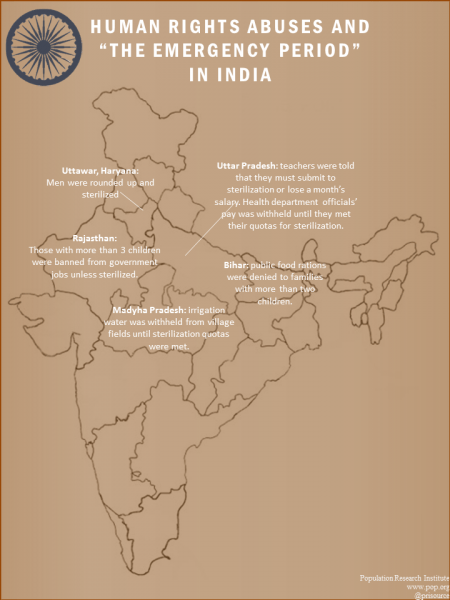
Several publications talk about a scene unfolding in a muslim dominated village of Uttawar, 50 miles south of New Delhi, where loudspeakers blared cautioning men of all age groups to convene in the centre of the village amongst the policeman mounted on horses, as if they had to herd the sheep towards these sterilisation camps. The north of India came to be known as the “Vasectomy Belt” with UP, MP and Rajasthan administration pursuing the campaign with a much unwanted passion. Men ranging between the age groups of 15 to 75 irrespective of their marital status or progeny status were sterilised. These state governments offered sweeteners like land allotment , easy loan facilities now that majority of the banks were nationalised and no credit check was required. Some lowly pot sweeteners were also dangled like food rations, clocks, household goods, butter etc. The government campaign in a time when there were not much sources of entertainment and social media was not invented yet was ” Men should allow the government to take the scalpel to their vas deferens”. Sometimes these sweeteners were discarded for more egalitarian methods like restricting jobs for people with less than 3 children, withholding irrigation water to fields if the males in the family were not sterilised or even administering loss of pay for government school staff if they resisted.

A total of 11 million men and women were sterilised between 1971 and 1977 with an astounding number of 6.2 million in one single year of 1976 during the emergency. The state and central government officials were monitored on their performance using the ” Success list” akin to the Kill list of the mob. This led to many botches during this 10-12 minute procedure with 2500 reported deaths on the table and others like unsuccessful procedures or further complications. Thank god for a few unsuccessful procedures, else India would have been another China, Japan, Korea with an ageing population rather than a country with 62% population under the age of 35 as it is known today.

Few of us know that this compulsory sterilisation continued beyond 1977 till 2013-2014 with the focus turned towards women assuming they would resist less. The campaign continued in the rural backward districts of India with 4 million sterilisation in one single year of 2013, a majority being women and only 100,000 men. The aspect came to limelight when 15 women of Chattisgarh died during the procedure and the current government had to put an end to it once for all.

In todays times of information overload or misinformation thanks to the ever growing tribe of intellectuals, liberals and their most loved medium of social media, what would a campaign like this lead to? Would the right to dissent have still persisted if the campaign was launched sans the emergency? Why do we the educated class of Indian society forget the real era when democracy was trampled, fundamental rights were thrown askew and don’t seen to remember the harbingers of the same ? We indeed are forgiving as a civilisation. We need to introspect and choose topics that require debate, resistance, protest and measure them on scale of either human rights or scathing need towards development. This rewind to the past should stand as a reminder and help us make that choice amongst the issues which our country faces today. As it’s said ” restraint towards dissent ” and “choice to dissent” are important aspects of exercising our fundamental rights.

Jai Hind!

Source: BBC, Nov 2014; Motivating Men- social science & the regulation of Men’s reproduction in postwar India- Savina Balakrishnan, 2018; Tarlo (2003); 1976-more than 6 million men in India were coerced into sterilisation, C.Brian Smith, 2019

Blog#2-NRC- To be Proven or Unproven

The intellectual denizens of our country are busy evaluating the 2020 Fiscal budget, a lacklustre record breaking speech which led to the sole analysis of the individual income tax structure. What it has atleast done is that it stole the thunder for a few weeks from the most debated topic for the last 2 months, the NRC!!

My first blog delved on the aspects of the CAA but its seems the linkage between that and the NRC doesn’t seem to wane off. The intellectuals of India are steadfast in promoting their interpretation since as they say “ perception is such a unsurmountable barrier that it starts and ends with bigotry.”

CAA has now become the fashionable protests of the elite, the intellectuals, the so called liberals and has also roped in the student population. Is it a repetition of the most popular student movement in India, The Assam Movement? Doesn’t seem like. The prominent universities of India like the JNU (of which even i am an alumnus although through one of the best campuses in Asia, The National Defence Academy) have become enrolment centres of protests. It seems students don’t join them for pursuing academic interests but to gain prominence through their memberships in public protests and ancillary bodies.

The entire foundation of the linkage between CAA & NRC is the protection of the rights of so called minorities in India and mainly that of Indian Muslims who ironically are not threatened by either. What is being forgotten is that Article 29 of the Constitution of India protects the interests of a sub section of citizens with a distinct cultural and linguistic identity by granting them a right to protect their language, script and culture. That’s innate pluralism. Article 30 of the Constitution empowers the minorities with a right to set up their own educational institutions but the majority does not have the right to do so. If cultural, linguistic identity defines a minority then even the practitioners of Hindu religion basis language, script and culture could be divided into several minority groups! No one seem to be bothered on this distinction.

The situation in the country today is simmering on the protective discrimination by the CAA which actually was proposed in 2003 and was presided over by establishment of a committee comprising of current members of opposition who seem to have forgotten their own recommendations. The leftists including their eminent leaders like Prakash Karat had in 2012 sent a letter to then PM of India imploring the govt to take steps to stop the persecution faced by minorities in islam dominated Bangladesh. Thats bigotry. The shaheen bagh ‘sit in’ in New Delhi is all about speeches of division of India and the extent of radicalisation is visible through the slogans chanted by children and their mothers ( however I condemn the shooter episode and the slogans. There are nutjobs on both sides of any issue always). It’s a ticking time bomb if not controlled now.

Now coming to the NRC. Why is it required? The situation of illegal immigration has taken a new dimension. In Bangladesh by 2050, 17% of its land mass shall get submerged leading to displacement of 18 Mn people which can also increase to 50 Mn in totality. Where shall they turn towards? India and its porous borders is the most obvious answer. NRC is an important step to support and protect the demographic unity of India. The first pilot of NRC was conducted between 2003-2009 which further was attempted in 2010 in the border states. This means its not a new process and has been considered from the time of creation of the first register in 1951. The need for it now cannot be more significant.

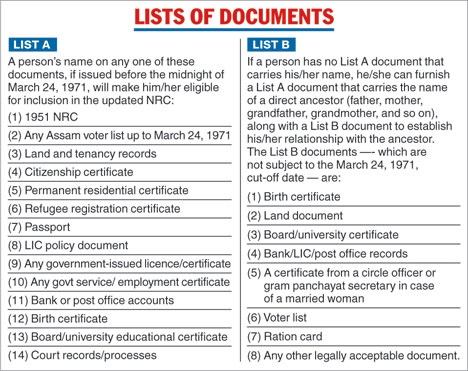
The govt has yet not published the structure or the operating process of this exercise but the SCARE MONGERING is at its peak!!The only precedence is the NRC process of Assam where 33 Mn people applied and out of which 31 Mn were found eligible. The balance of 1.9 Mn shall have to approach the foreigner tribunal for resolutions. However, this result of 1.9 Mn people being ineligible is being touted as failure of the process, whereas the lack of documentation amongst these people that they could not produce is not being questioned. The perception that is being created is that the documentation required is too archaic and leads to harassment of the citizens. Well, lets look at the document lists published by govt of India for Assam and endorsed by Supreme Court of India. It consists of List A and List B. The lists in themselves are so exhaustive that you would question the disposition of an individual who does not have any of them. Even the persecuted minorities under the CAA have to submit a list of documents to prove that they were persecuted minorities. They would also have to conform to the norms of FRO over and above the List A and B. But there is so much of hyperventilation on the sword that hangs over without even knowing the process that shall be followed.


( Source: Office of the state coordinator of National registration of Assam)

Our longstanding neighbour, Pakistan relentlessly is trying to influence the people within India and now some parts of world of the Nazism which is taking shape here. The irony of it seems to be lost that a country famous for religious persecution is blaming a country which is coming out with a legislation to protect religious minorities.

The process of NRC is not new to nations of the world. In a different form it’s part of the electoral voter registration process in the US before any Presidential election. Their strict immigration process and the social security database acts as an aid to the process. The ideal state of Singapore regularly conducts a registration of their citizens and permanent residents. The last was conducted in November 2019 for those who were born between 01 Oct 2002 and 01 Jan 2003. A country which boasts an equal population like India which is China has been historically conducting these registrations under a process of household registration called ‘Hukou’. But it seems parts of the world namely the EU have a problem with India conducting one, which is the latter’s internal political matter.

In the end let me leave you with a thought to what extent should an issue be debated………The original document written as a constitution of India had a painting of Lord Ram at the head of the page which spoke about ‘Fundamental Rights’. An attempt to say that the fundamental rights to a citizen emboldens him or her to do the right thing in conduct and follow the example set by Lord Ram in our mythological history. It’s the same document which protects the rights of every minority and sub group through Article 14, 29 and 30. If the constitution were to be written today will the leftists and so called liberals allow for such depiction or raise it as an un secular move?!! Are we ignoring and discounting the vast history and traditions of one of the oldest living civilisations of mankind. That by me is intellectual skullduggery!

Jai Hind!!

Source credits: Opinion by J Sai Deepak, Advocate , The Supreme Court of India; Office of state coordinator of National registration of Assam

Blog#1-CAA-An consequential inconsequence

When the country is reeling under protests and debates, I pen my first blog inspired by a fiery young man with immense promise and ability to make a change. Our opinions may differ but Abhinav Chandar, your writings pulled me to a point of finally taking that leap. More power to you.

There were many aspects that Abhinav had covered on the CAA/CAB and had interlinked the state of affairs of the economy and also the right to equality amongst others including the debatable NRC. These linkages of several unique and isolated topics is now a common platform for the debate, protests and dissent.

It’s important to analyse each one of them in their own right and base one’s opinions on facts rather than interpretations. In times like these a rational outlook is seen as sitting on the fence and am glad to be on that spectrum for some of these issues.

CAA

The interpretation of this amendment by non constitutional law experts created the base for confusion and misinterpretations. Hence, I refer to an opinion tendered by a legal expert serving as an advocate in the Supreme Court of India, J. Sai Deepak.

The act is a limited amendment to the legislation of granting citizenship to immigrants from basically 3 nations of Pakistan, Bangladesh and Afghanistan who belong to Hindu, Jain, Buddhist, Parsi, Sikh and Christians religious faiths. The clear distinction is that this is an act of limited inclusion and not exclusion of Muslims immigrants, which is not referenced to, basis their entitlement to individual citizenship through the normal process of naturalisation. But why only these 3 nations and why those specific religions is the question? One, is that the persecution of minorities based on religious preferences is rampant in these nations and second that these nations at some point in history were part of the undivided Indian sub-continent, hence given the lineage they have shared cultures and disposition. This was understood post partition too and hence the Nehru-Liaquat pact of 1950 between undivided Pakistan and India which specified that minorities of the two countries would be taken care of by the respective governments and their rights shall be protected. This was basis the critical hostage theory of using the treatment of minorities in your country to demand the safety and protection of minorities in the neighbouring nation.

The Nehru-Liaquat pact since then has lost its practical ground and evidence of the same is starkly visible through some statistics. Prior to 1971 the population of minorities, non Muslims in undivided Pakistan ranged at 23% of the population which post 1971 became 3% with 20% share taken up by the new nation formed as Bangladesh. This 3% is today 1.8%, through the outward claims are that population of non Muslims has risen to 1.8% in the last few years from 1.3%. In case of Bangladesh this 20% is now lower than 11%. It’s a classic example of how you view the problem. The question that would be a natural progression is that how would have the population mix changed in these countries? Either there were large scale migrations of minorities from these two countries to other nations including India or they would have been subsumed in the local population by altering their faith or would have been killed or have died without progeny. Either ways this would be a deviation from the Nehru-Liaquat pact of 1950.

In case of Afghanistan the emergence of Taliban brought intense radicalisation of islam leading towards stringent version of islam which was not acceptable to large swathes of local population. This led to the exodus of the population who were welcomed by India as refugees. This could be debated as one of the strategic moves with a defined objective in the early 2000s. The argument that if the afghans were welcomed, then why not ahmadiyas or Shias of Pakistan who are subject to sectarian violence? It’s been long known that these two sects of islam have very strong views on other religions especially idol worship and with belief in their own version of islam they could posses a huge risk to our current Indian muslim population and their faith. Would we risk that? In my view this would be a way to protect the sanctity and integrity of our Indian Muslims who are our own.

Linkage of CAA to Article 14 of the Constitution & NRC

The linkage seems so natural given the fact that there is mention of some set of religions in the CAA. However, this would be highly unconstitutional if the two were linked since it would bestow different set of rights to minorities to be treated differently under various circumstances. The current linkage by one and all is outside the gamut of constitutional law which would take a route of closest proximity of all the special and general provisions to the main issue to form a legal interpretation. This means that neither article 14 nor CAA can be viewed in isolation. Article 14 is part of the Part 3 of the constitution whereas the aspects of citizenship are covered in the Part 2 through articles 5 to 11. Article 11 clearly states that grant of citizenship may be subject to any other law that the government may pass in the parliament to this regard. Therefore articles 5 to 11 need to be interpreted in conjunction with the citizenship act of 1955 which leads to the CAA coupled with the Foreigners act of 1946 which leads to the NRC. Any amendment passed by the parliament which does not nullify articles 5 to 11 of the constitution & citizenship act of 1955 is deemed to be constitutional. This is while retaining the fact that secularism is part of our Preamble and one of the basic structures of the Indian Constitution.

That brings to another bone of contention, the NRC. If at all there is a national wide exercise conducted on NRC and if Indian Muslims or Hindus or citizens of India of any faith stand to be excluded as per the guidelines then the belief that citizens of all other faiths other than islam would be protected due to the provisions of CAA is a myth being propagated. The CAA and the NRC interlinkage does not apply to existing citizens of India except in case of Assam. That is the real issue. The situation in Assam has escalated due to the years of negligence by Govt of India towards controlling the inflow of immigrants in that state. With 1.3 Mn foreign immigrants, the state would be in a flux and issue of Assam is more critical that the debate on exclusion of Muslims at this point of time.

In the end its the narrative which takes precedence in these modern times with social media and the press leading the charge of which I too am a culprit! What’s more frightening is that people now are delving into the past to say that India is entering the early stages of Facism and compare the CAA with the Nuremberg law of the pre world war Germany. I sincerely hope and pray not for someone to prove the facts towards their similarity or otherwise, but that this does not become the main narrative propagated in our country given most of us are social media trigger happy through our ordnance of WhatsApp, FB and twitter! ( Thank god Tinder does not encourage debates !! )

Jai hind