On a lazy Saturday afternoon, flicking through Netflix and other channels, I chanced upon an intriguing title of a Zee Original movie named “Shukranu” ( English meaning sperm). Seems it was a funny adaption on the compulsory sterilization campaign during the era of emergency in India between 1975-1977. The topic and movie itself piqued my interest and led to further research on this topic. I chose today, the day dedicated to women, the ” International Women’s Day” to pen my opinion on a topic which impacted and still impacts both genders.
The Background– It dates back to the late 60’s and early 70’s when Mrs Indira Gandhi, the daughter of Pandit Jawahar Lal Nehru and the then Prime Minister of India had achieved full control of the government and her own political party, The Indian National Congress (INC). This drive for full power led to the INC being divided as Congress (O), the old guard and the Congress (R) her own faction. The latter became an institution fuelled by ostentatious displays of sycophancy towards her and her family by members of the erstwhile INC, who felt their possibility of survival only depended on appeasing her and her son, the main character of our topic here.
The period prior to the emergency was backed by Mrs Gandhi’s charismatic appeal to the masses and perception of an approach of socialism and secularism to support the poor and the backward classes in India. This led to several socialist moves and to name a few, nationalisation of several banks ( being merged now due to years of mismanagement) and abolition of the privy purses which the erstwhile royal families of pre independent India were promised as part of the deal to join and form the Independent India. All of this implemented through an ordinance and not a parliament approved legislation in so called democracy. When the Supreme Court of India passed an order that the constitution cannot be amended by the parliament, Mrs Gandhi with support of Congress (R) passed the 24th amendment and the 26th amendment , the latter legalised her move to abolish the privy purses which was also questioned by the apex court. So much for the third pillar of democracy the “Judiciary” touted today by the intellectuals and liberals of the society whose predecessors didn’t seem to protest all of this in the early 70’s and were busy eating out of the Lutyen’s platter. Mrs Gandhi displayed repugnance towards the apex court by appointing A.N. Ray as the Chief Justice of India and superseded 3 senior candidates for the job. Her man planted on the so called “Third Pillar”.
The final nail to the coffin to announce the emergency in the country was the Raj Narain verdict passed after 4 years of the appeal in the Allahabad High Court and upheld by the apex court. The verdict pronounced Mrs Gandhi guilty of misconduct during elections in the state of UP, misuse of power through government officials among few others like bribing. Thus, as the verdict was announced on 24 June 1975, two days later on 26 June 1975 through the President of India, with her own cabinet being uninformed, the Emergency was declared in the world’s largest democracy. The new version of “Dynastic politics” had begun its journey.
The 12 Minute Ordeal– In the quintessential style of Dante’s Inferno, a campaign was started and spearheaded by the self proclaimed heir of Mrs Gandhi, her son, Sanjay Gandhi. This was the mass compulsory sterilisation campaign aimed at men. Yes, the population was bursting at its seams like today and resources were a handful but this approach to the problem was a typical preadaptation of the wild western flicks we are used to. In 1975-76, men in rural India started displaying a fear of being sterilised and thus abandoned their beds to sleep in their fields and even stopped attending public functions or family gatherings.
Several publications talk about a scene unfolding in a muslim dominated village of Uttawar, 50 miles south of New Delhi, where loudspeakers blared cautioning men of all age groups to convene in the centre of the village amongst the policeman mounted on horses, as if they had to herd the sheep towards these sterilisation camps. The north of India came to be known as the “Vasectomy Belt” with UP, MP and Rajasthan administration pursuing the campaign with a much unwanted passion. Men ranging between the age groups of 15 to 75 irrespective of their marital status or progeny status were sterilised. These state governments offered sweeteners like land allotment , easy loan facilities now that majority of the banks were nationalised and no credit check was required. Some lowly pot sweeteners were also dangled like food rations, clocks, household goods, butter etc. The government campaign in a time when there were not much sources of entertainment and social media was not invented yet was ” Men should allow the government to take the scalpel to their vas deferens”. Sometimes these sweeteners were discarded for more egalitarian methods like restricting jobs for people with less than 3 children, withholding irrigation water to fields if the males in the family were not sterilised or even administering loss of pay for government school staff if they resisted.
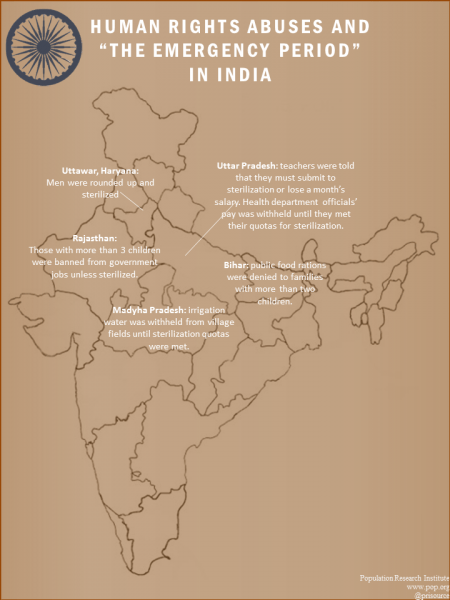
A total of 11 million men and women were sterilised between 1971 and 1977 with an astounding number of 6.2 million in one single year of 1976 during the emergency. The state and central government officials were monitored on their performance using the ” Success list” akin to the Kill list of the mob. This led to many botches during this 10-12 minute procedure with 2500 reported deaths on the table and others like unsuccessful procedures or further complications. Thank god for a few unsuccessful procedures, else India would have been another China, Japan, Korea with an ageing population rather than a country with 62% population under the age of 35 as it is known today.
Few of us know that this compulsory sterilisation continued beyond 1977 till 2013-2014 with the focus turned towards women assuming they would resist less. The campaign continued in the rural backward districts of India with 4 million sterilisation in one single year of 2013, a majority being women and only 100,000 men. The aspect came to limelight when 15 women of Chattisgarh died during the procedure and the current government had to put an end to it once for all.
In todays times of information overload or misinformation thanks to the ever growing tribe of intellectuals, liberals and their most loved medium of social media, what would a campaign like this lead to? Would the right to dissent have still persisted if the campaign was launched sans the emergency? Why do we the educated class of Indian society forget the real era when democracy was trampled, fundamental rights were thrown askew and don’t seen to remember the harbingers of the same ? We indeed are forgiving as a civilisation. We need to introspect and choose topics that require debate, resistance, protest and measure them on scale of either human rights or scathing need towards development. This rewind to the past should stand as a reminder and help us make that choice amongst the issues which our country faces today. As it’s said ” restraint towards dissent ” and “choice to dissent” are important aspects of exercising our fundamental rights.
Jai Hind!
Source: BBC, Nov 2014; Motivating Men- social science & the regulation of Men’s reproduction in postwar India- Savina Balakrishnan, 2018; Tarlo (2003); 1976-more than 6 million men in India were coerced into sterilisation, C.Brian Smith, 2019
 Musings of a realist
Very well written . In today’s time we need to introspect a lot . At times leaders becomes taller then the people , Indira Gandhi and Sanjay were examples of such a period . At times I think , are we again creating some thing like that . Your blog is full of information backed by exact data . Dance of democracy gets bad at Times . People should really introspect
LikeLike
That’s true..
LikeLike
Insightful. Prods you to ponder. Reminds me of a Chanakya(?) quote,”Governance is possible only through assistance. A single wheel does not move”
In the haze of the mad ‘dance of democracy’ leaders shift to autocracy, perhaps in megalomaniac stupor and history stands evidence what lives on.
Just too many Ozymandias around and the plebeians despair !
LikeLike
So agree with you. Hence even the current government needs to ponder on that autocratic streak. However sometimes too many opinions make execution a second priority. By the way love the last statement of your comment.
LikeLiked by 1 person
Insightful!
LikeLiked by 1 person